

NADH —— Ein Schlüsselmolekül der zellulären Energieproduktion

Einleitung
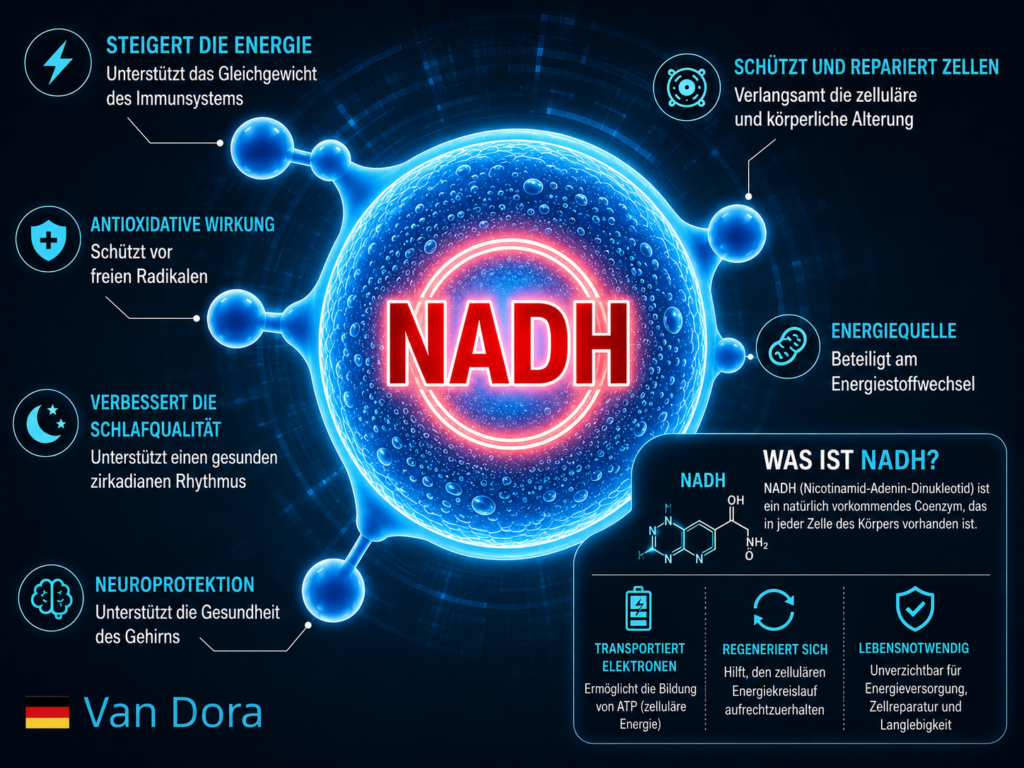
NADH (reduziertes Nicotinamidadenindinukleotid) gehört zu den wichtigsten Coenzymen, die natürlicherweise im menschlichen Körper vorkommen. Es spielt eine zentrale Rolle im zellulären Energiestoffwechsel und ist an zahlreichen biologischen Prozessen beteiligt, die für die Aufrechterhaltung normaler physiologischer Funktionen erforderlich sind.
Jede Sekunde sind Milliarden von Körperzellen auf NADH angewiesen, um Nährstoffe aus der Nahrung in nutzbare Zellenergie umzuwandeln. Ohne ausreichende Mengen an NADH könnten die körpereigenen Energiegewinnungsprozesse nicht effizient ablaufen.
⸻
Was ist NADH?
NADH ist die reduzierte Form von Nicotinamidadenindinukleotid (NAD+), einem natürlichen Coenzym, das in allen lebenden Zellen vorkommt.
NAD+ und NADH bilden ein biologisches Redox-Paar:
- NAD+ nimmt Elektronen auf.
- NADH transportiert und spendet Elektronen.
Gemeinsam sind sie an Hunderten von Stoffwechselreaktionen beteiligt und spielen insbesondere bei der Energiegewinnung in den Mitochondrien eine wichtige Rolle.
Aufgrund seiner zentralen Bedeutung für den Zellstoffwechsel wird NADH häufig als eines der wichtigsten energiebezogenen Coenzyme des Körpers bezeichnet.
⸻
Wie unterstützt NADH die zelluläre Energieproduktion?
Die Hauptaufgabe von NADH besteht darin, Elektronen während der Zellatmung zu transportieren.
Beim Stoffwechsel von Kohlenhydraten, Fetten und Proteinen laufen folgende Schritte ab:
1. Nährstoffe werden in kleinere Moleküle zerlegt.
2. NAD+ nimmt Elektronen auf und wird zu NADH reduziert.
3. NADH transportiert diese Elektronen zur mitochondrialen Elektronentransportkette.
4. Die Elektronentransportkette nutzt die dabei freiwerdende Energie zur Bildung von ATP (Adenosintriphosphat).
ATP gilt als die wichtigste Energiewährung des Körpers und versorgt nahezu alle zellulären Prozesse mit Energie.
Als bedeutender Elektronendonator trägt NADH wesentlich zu einer effizienten ATP-Produktion bei.
⸻
NADH und die Funktion der Mitochondrien
Mitochondrien werden häufig als „Kraftwerke der Zelle“ bezeichnet, da sie den Großteil des körpereigenen ATP erzeugen.
NADH gehört zu den zentralen Molekülen des mitochondrialen Energiestoffwechsels. Durch die Bereitstellung energiereicher Elektronen für die Elektronentransportkette unterstützt NADH die biochemischen Prozesse, die eine effiziente Energiegewinnung in den Zellen ermöglichen.
Die wissenschaftliche Forschung untersucht weiterhin den Zusammenhang zwischen mitochondrialer Gesundheit, zellulärer Energieproduktion und gesundem Altern.
⸻
NADH und gesundes Altern
Wissenschaftliche Untersuchungen zeigen, dass die zelluläre Energieproduktion und die Effizienz der Mitochondrien mit zunehmendem Alter abnehmen können.
Gleichzeitig wurden in bestimmten Geweben altersbedingte Veränderungen von NAD-bezogenen Molekülen beobachtet. Daher erforschen Wissenschaftler deren mögliche Rolle bei biologischen Alterungsprozessen.
Obwohl NADH und NAD+ Gegenstand intensiver Forschung sind, ist es wichtig zu beachten, dass die Europäische Behörde für Lebensmittelsicherheit (EFSA) derzeit keine spezifischen gesundheitsbezogenen Angaben zu Anti-Aging-Effekten von NADH zugelassen hat.
Die bisherige Evidenz rechtfertigt weiteres wissenschaftliches Interesse, jedoch sind zusätzliche Studien erforderlich, um eindeutige Schlussfolgerungen zu ziehen.
⸻
Aktuelle Forschungsgebiete
Wissenschaftler untersuchen NADH derzeit in verschiedenen Bereichen, darunter:
- Zellulärer Energiestoffwechsel
NADH fungiert als wichtiger Elektronenträger bei der ATP-Bildung und der zellulären Energieproduktion.
- Mitochondriale Biologie
NADH steht in engem Zusammenhang mit der Funktion der Mitochondrien und der zellulären Bioenergetik.
- Oxidations-Reduktions-Gleichgewicht
NADH ist an der Aufrechterhaltung des zellulären Redox-Gleichgewichts beteiligt, das für normale Zellfunktionen von Bedeutung ist.
- Neurowissenschaftliche Forschung
Wissenschaftler untersuchen weiterhin die Rolle des Energiestoffwechsels für die Gehirnfunktion und die kognitive Gesundheit sowie die mögliche Beteiligung NADH-abhängiger Stoffwechselwege.
⸻
Was ist der Unterschied zwischen NAD+ und NADH?
Obwohl sie eng miteinander verwandt sind, stellen NAD+ und NADH zwei unterschiedliche Formen desselben Coenzyms dar, die gemeinsam am Energiestoffwechsel beteiligt sind.
NAD+ ist die oxidierte Form und nimmt Elektronen auf. Nach der Aufnahme von Elektronen wird es zu NADH reduziert. NADH ist die reduzierte Form und fungiert als Elektronenträger, der Elektronen für die ATP-Produktion bereitstellt. Nachdem NADH seine Elektronen abgegeben hat, wird es wieder zu NAD+ oxidiert.
Dieser fortlaufende Kreislauf zwischen NAD+ und NADH ist für die zelluläre Energiegewinnung und einen normalen Stoffwechsel von grundlegender Bedeutung.
⸻
Fazit
NADH ist ein natürlich vorkommendes Coenzym, das eine zentrale Rolle bei der zellulären Energieproduktion, der mitochondrialen Funktion und zahlreichen Stoffwechselprozessen im menschlichen Körper spielt.
Mit dem wachsenden wissenschaftlichen Verständnis der zellulären Bioenergetik bleibt NADH ein wichtiges Forschungsgebiet in den Bereichen Energiestoffwechsel, mitochondriale Gesundheit und gesundes Altern.
Verbraucher sollten jedoch berücksichtigen, dass viele potenzielle Anwendungsgebiete von NADH weiterhin wissenschaftlich untersucht werden. Eine ausgewogene Ernährung, regelmäßige körperliche Aktivität, ausreichend Schlaf und ein gesunder Lebensstil bilden nach wie vor die Grundlage für langfristiges Wohlbefinden.
⸻
Quellen:
1. Ying W. NAD+/NADH and NADP+/NADPH in Cellular Functions and Cell Death. Frontiers in Bioscience. 2006;11:3129-3148.
2. Verdin E. NAD+ in Aging, Metabolism, and Neurodegeneration. Science. 2015;350(6265):1208-1213.
3. Covarrubias AJ, Perrone R, Grozio A, Verdin E. NAD+ Metabolism and Its Roles in Cellular Processes During Ageing. Nature Reviews Molecular Cell Biology. 2021;22:119-141.
4. Belenky P, Bogan KL, Brenner C. NAD+ Metabolism in Health and Disease. Trends in Biochemical Sciences. 2007;32(1):12-19.
5. Pollak N, Dölle C, Ziegler M. The Power to Reduce: Pyridine Nucleotides—Small Molecules with a Multitude of Functions. Biochemical Journal. 2007;402(2):205-218.
⸻
Haftungsausschluss:
Dieser Artikel dient ausschließlich Informations- und Bildungszwecken. Er ist nicht dazu bestimmt, Krankheiten zu diagnostizieren, zu behandeln, zu heilen oder ihnen vorzubeugen.
Nahrungsergänzungsmittel sollten nicht als Ersatz für eine abwechslungsreiche und ausgewogene Ernährung sowie eine gesunde Lebensweise verwendet werden.