

Mitochondrien —— Die Kraftwerke der Zellen und ihre Rolle im Energiestoffwechsel

Einleitung
Jede Bewegung, jeder Gedanke, jeder Herzschlag und nahezu jeder biologische Vorgang im menschlichen Körper benötigt Energie. Doch woher stammt diese Energie?
Die Antwort liegt in winzigen Strukturen, die sich in fast jeder Körperzelle befinden: den Mitochondrien.
Mitochondrien werden häufig als die „Kraftwerke der Zelle“ bezeichnet, da sie den Großteil der Energie produzieren, die für das Leben erforderlich ist. Ihre Funktion gilt als ein wesentlicher Bestandteil des zellulären Energiestoffwechsels und steht im Mittelpunkt zahlreicher wissenschaftlicher Untersuchungen.
⸻
Was sind Mitochondrien?
Mitochondrien sind spezialisierte Zellorganellen, die in den meisten menschlichen Zellen vorkommen.
Im Gegensatz zu vielen anderen Zellbestandteilen verfügen Mitochondrien über eigene DNA und besitzen die Fähigkeit, Energie durch einen Prozess namens Zellatmung (celluläre Respiration) zu erzeugen.
Je nach Zelltyp kann eine einzelne Zelle wenige bis mehrere Tausend Mitochondrien enthalten.
Organe und Gewebe mit hohem Energiebedarf – beispielsweise Herz, Gehirn, Muskulatur und Leber – weisen besonders viele Mitochondrien auf.
⸻
Warum benötigen Zellen Energie?
Jede Zelle des Körpers erfüllt kontinuierlich zahlreiche Aufgaben, darunter:
- Aufbau und Reparatur von Geweben
- Transport von Nährstoffen
- Aufrechterhaltung der Zellkommunikation
- Unterstützung der Muskelkontraktion
- Steuerung biochemischer Reaktionen
Für all diese Prozesse wird Energie in Form von ATP (Adenosintriphosphat) benötigt.
ATP wird häufig als die „Energiewährung“ des Körpers bezeichnet, da es unmittelbar verfügbare Energie für zelluläre Funktionen bereitstellt.
Ohne ATP könnten Zellen ihre normalen Aufgaben nicht erfüllen.
⸻
Wie erzeugen Mitochondrien Energie?
Mitochondrien produzieren ATP über einen komplexen Prozess, der als oxidative Phosphorylierung bezeichnet wird.
Der Prozess beginnt mit dem Abbau von Nährstoffen aus der Nahrung – insbesondere Kohlenhydraten, Fetten und Proteinen.
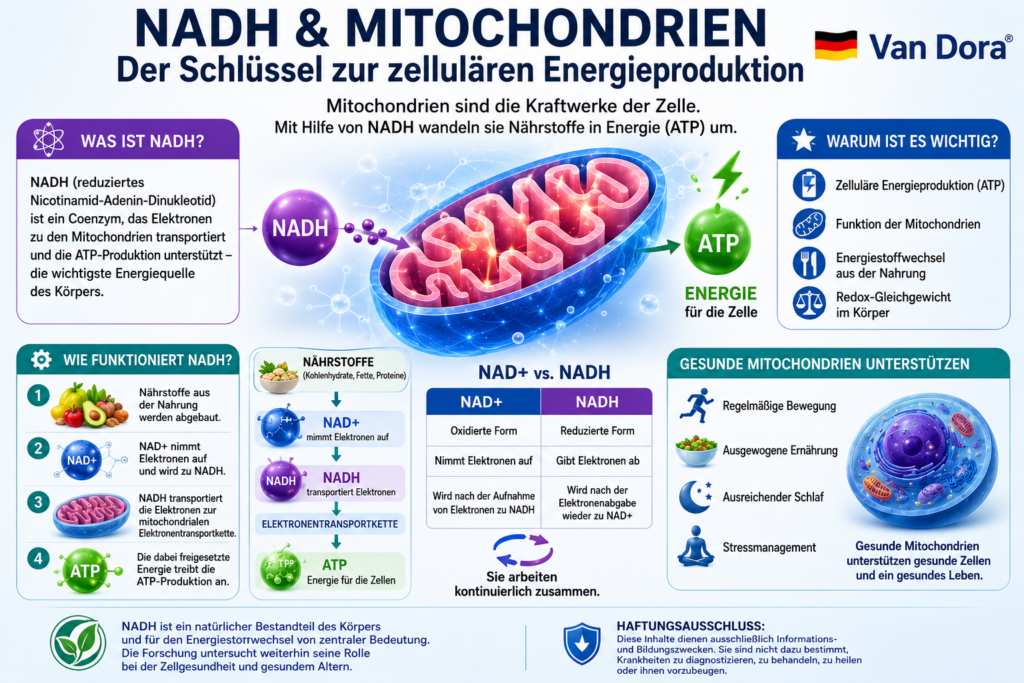
Innerhalb der Mitochondrien laufen dabei mehrere Schritte ab:
1. Nährstoffe werden in kleinere Moleküle umgewandelt.
2. Coenzyme wie NADH transportieren energiereiche Elektronen.
3. Diese Elektronen gelangen in die mitochondriale Elektronentransportkette.
4. Die dabei freigesetzte Energie wird zur Bildung von ATP genutzt.
Dieses hocheffiziente System ermöglicht die Produktion des überwiegenden Teils der körpereigenen Energie.
Aus diesem Grund werden Mitochondrien häufig mit kleinen Kraftwerken verglichen, die in jeder Zelle arbeiten.
⸻
Die wichtige Rolle von NADH
Eines der zentralen Moleküle bei der mitochondrialen Energiegewinnung ist NADH (reduziertes Nicotinamidadenindinukleotid).
NADH fungiert als Elektronenträger. Es transportiert Elektronen, die während des Nährstoffstoffwechsels entstehen, zur mitochondrialen Elektronentransportkette.
Diese Elektronen liefern die Energie, die für die ATP-Produktion benötigt wird.
Ohne Moleküle wie NADH würde die Umwandlung von Nährstoffen in nutzbare Zellenergie deutlich weniger effizient ablaufen.
Daher wird NADH häufig als ein wichtiger Bestandteil der zellulären Bioenergetik beschrieben.
⸻
Mitochondrien und die Zellgesundheit
Neben ihrer Rolle bei der Energieproduktion sind Mitochondrien an zahlreichen weiteren zellulären Prozessen beteiligt, darunter:
- Zelluläre Signalübertragung
- Regulation des Calciumhaushalts
- Aufrechterhaltung des zellulären Redox-Gleichgewichts
- Anpassung an Veränderungen der Umgebung
Aufgrund ihrer vielfältigen Funktionen erforschen Wissenschaftler weiterhin die Bedeutung der Mitochondrien für die Aufrechterhaltung normaler Zellfunktionen.
⸻
Was geschieht im Laufe des Alterns?
Wissenschaftliche Untersuchungen deuten darauf hin, dass sich die Effizienz der Mitochondrien im Laufe des Lebens verändern kann.
Altersbedingte Veränderungen der mitochondrialen Funktion sind Gegenstand intensiver Forschung in den Bereichen Zellbiologie und gesundes Altern.
Besonderes Interesse gilt dabei der Frage, wie die zelluläre Energieproduktion mit physiologischen Veränderungen im Alter zusammenhängt.
Viele Aspekte dieser Zusammenhänge werden jedoch weiterhin untersucht, und zusätzliche Forschung ist erforderlich, um die zugrunde liegenden Mechanismen vollständig zu verstehen.
⸻
Unterstützung einer gesunden mitochondrialen Funktion
Mitochondrien passen sich kontinuierlich an die Bedürfnisse des Körpers an. Mehrere Lebensstilfaktoren stehen mit einem normalen Energiestoffwechsel in Zusammenhang:
- Regelmäßige körperliche Aktivität
Bewegung erhöht den Energiebedarf des Körpers und fördert Anpassungsprozesse im Energiestoffwechsel.
- Ausgewogene Ernährung
Eine abwechslungsreiche Ernährung liefert wichtige Nährstoffe, die an Stoffwechselprozessen beteiligt sind.
- Ausreichender Schlaf
Schlaf spielt eine wichtige Rolle für Regeneration und Energiehaushalt.
- Stressmanagement
Langfristiger Stress kann verschiedene Stoffwechselprozesse beeinflussen und Auswirkungen auf die allgemeine Zellfunktion haben.
Die Pflege gesunder Lebensgewohnheiten kann dazu beitragen, die natürlichen energieproduzierenden Systeme des Körpers zu unterstützen.
⸻
Fazit
Mitochondrien werden als „Kraftwerke der Zelle“ bezeichnet, weil sie den Großteil des ATP produzieren, das nahezu alle zellulären Aktivitäten mit Energie versorgt.
Durch komplexe biochemische Prozesse, an denen Nährstoffe, Sauerstoff und Coenzyme wie NADH beteiligt sind, wandeln Mitochondrien Nahrung in nutzbare Zellenergie um.
Mit dem zunehmenden wissenschaftlichen Verständnis der zellulären Bioenergetik bleiben Mitochondrien ein zentrales Forschungsgebiet in den Bereichen Energiestoffwechsel, Zellfunktion und gesundes Altern.
⸻
Quellen:
1. Nunnari J, Suomalainen A. Mitochondria: In Sickness and in Health. Cell. 2012;148(6):1145-1159.
2. Spinelli JB, Haigis MC. The Multifaceted Contributions of Mitochondria to Cellular Metabolism. Nature Cell Biology. 2018;20(7):745-754.
3. Wallace DC. Mitochondria and Health. Nature Reviews Genetics. 2005;6(6):485-497.
4. Chandel NS. Evolution of Mitochondria as Signaling Organelles. Cell Metabolism. 2015;22(2):204-206.
5. Verdin E. NAD+ in Aging, Metabolism, and Neurodegeneration. Science. 2015;350(6265):1208-1213.
⸻
Haftungsausschluss:
Dieser Artikel dient ausschließlich Informations- und Bildungszwecken und stellt keine medizinische Beratung dar. Nahrungsergänzungsmittel sind nicht dazu bestimmt, Krankheiten zu diagnostizieren, zu behandeln, zu heilen oder ihnen vorzubeugen.
Nahrungsergänzungsmittel sollten nicht als Ersatz für eine abwechslungsreiche und ausgewogene Ernährung sowie eine gesunde Lebensweise verwendet werden.